
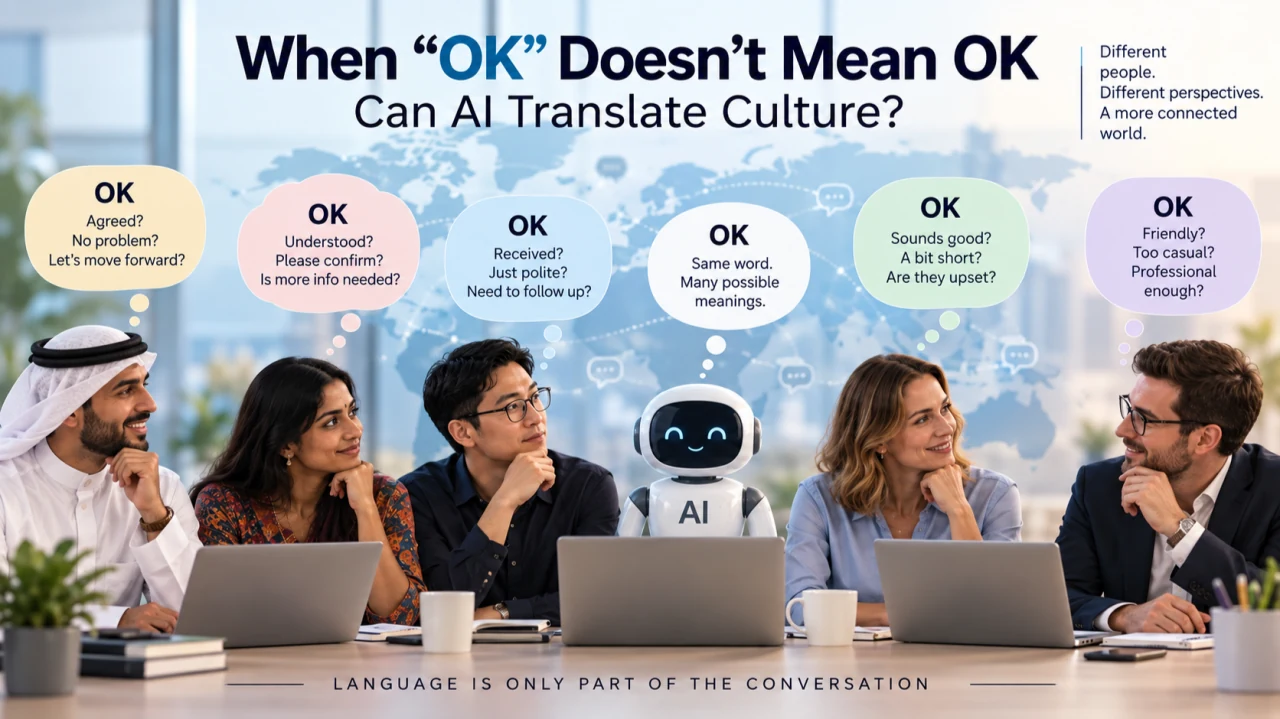
Why good localization must consider intent, tone and audience—not just correct words.
A message can be perfectly understandable and still leave the wrong impression. Anyone who has worked with international teams has probably experienced this: a colleague sends a short reply, and the recipient reads far more into it than the sender intended.
“OK.”
Did they agree? Are they annoyed? Is the conversation over? Or did they simply reply between meetings?
The words are the same, but people can interpret them very differently. That raises an important question for companies using AI to communicate across languages: is a correct translation enough if the tone or intention gets lost?
The words can be correct while the message is wrong
Translation is often described as transferring meaning from one language to another. In practice, meaning includes much more than the dictionary definitions of words. A message also carries expectations about politeness, formality, directness and the relationship between the people communicating.
Take a routine request: “Can you send me this by Friday?” In one workplace it sounds like an ordinary, courteous question. In another, a recipient may perceive it as unusually direct. A more indirect version—“Perhaps you could look at this when you have a moment?”—might sound considerate to some people and frustratingly vague to others.
Neither writer necessarily intended anything negative. Yet the effect on the reader can be quite different.
That does not mean people from one country all communicate in the same way. Culture matters, but so do personality, workplace norms, age, context and the relationship between individuals. The goal of localization is not to apply national stereotypes. It is to understand who the message is for and how it should be received.
Consider a customer-support message
Imagine a company sending this to a customer:
“We need you to provide this information again.”
The sentence is clear. A translation may be grammatically flawless. But in some contexts, the customer might read it as impatient or accusatory, especially if they have already submitted the information once.
Compare it with:
“It looks like we still need a few details. Could you please send them again?”
The second version does not change the underlying request. It changes the relationship the company creates with the customer.
Likewise, an app that says “You failed to complete the process” may technically describe what happened, but “The process wasn't completed. Please try again” may be a more helpful choice. The right wording depends on the brand's voice, the product, the audience and the circumstances—not merely on the source sentence.
This is why localization and communication strategy need to work together. A linguistically accurate sentence can still be the wrong sentence for the user.
Even punctuation and emojis change the tone
Short written messages leave room for interpretation. Compare “Thanks!”, “Thanks.” and “Thanks…” or “OK” and “OK 👍”. Many readers will hear a different tone in each version, even though the core words barely change.
An emoji may soften a message for one audience but seem inappropriate, sarcastic or overly casual to another. The same is true of punctuation. It is tempting to assume that adding a symbol solves the problem of tone, when sometimes it creates a new one.
For global companies, these details matter across customer support, software interfaces, onboarding flows, chatbots, automated emails, subscription notices, help centres and marketing campaigns. A small change in wording can affect whether an instruction feels helpful, confusing or unnecessarily confrontational.
Where AI helps—and where it needs direction
AI systems can be very useful for adapting messages. They can propose alternative phrasings, compare levels of formality and identify language that might come across as too harsh or too casual.
But the quality of those suggestions depends on the information the system receives.
“Translate this into Chinese” is not the same assignment as: “Translate this message for a professional exchange with a senior colleague. Keep the tone respectful but not excessively formal.”
The second request provides the relationship and communication goal, not only the target language. That context changes the task.
Research on culture-aware machine translation has explored this distinction and identified differences in how successfully language models handle culture-dependent meaning. It also suggests that knowing a cultural fact and applying it appropriately in a particular translation are not the same thing. These findings are useful, but they should not be interpreted as proof that every model or every language combination behaves alike.
Human translators can misread context too. If the source is just three words and a punctuation mark, neither a linguist nor an AI system can be expected to know everything about the intended tone. The difference today is scale: automated systems can repeat the same unsuitable wording across thousands of customer interactions before anyone notices.
Translate the intention, not only the sentence
For multilingual customer communication, we believe a stronger workflow starts by answering a few simple questions:
- Who is speaking, and to whom? A service notification, a colleague's request and a formal warning are different situations.
- What should the reader understand or do? Preserve the intended action and the level of urgency or obligation.
- What tone should the brand use? Give language teams clear guidance on politeness, empathy, formality and style.
- What context does the linguist or AI system need? Supply screenshots, communication scenarios and relevant examples instead of isolated strings.
- Who checks the finished message? Use native-language, culturally aware review where the customer impact justifies it.
None of this means that every message needs an elaborate cultural review. The effort should reflect the importance of the content. But companies should not assume that fluent output has automatically preserved the intended tone.
A more useful question for international communication
Perhaps the question is not simply, “How do we say this in another language?”
It is: “How should we communicate this message to this particular audience?”
That is where linguistic expertise, audience knowledge and well-guided AI can work together. Tools can help companies communicate faster and at greater scale, but they still need clear instructions and sensible quality checks.
At MITO Solutions, we approach localization as part of the user's overall experience. Our work combines language expertise, linguistic quality assurance and AI-aware workflows, with attention to terminology, tone and the intended audience. Hungarian is our main language specialization, while our experience managing multilingual projects informs the way we approach broader localization challenges.
If your team is adapting software, customer communication or product content across languages, we'd be happy to discuss how better context and review processes can help protect the meaning behind the words.
Explore MITO Solutions · Contact us
Adapted for MITO Solutions from an article by Miklós Tóth, originally published on LinkedIn on 9 September 2026. Read the original article.