
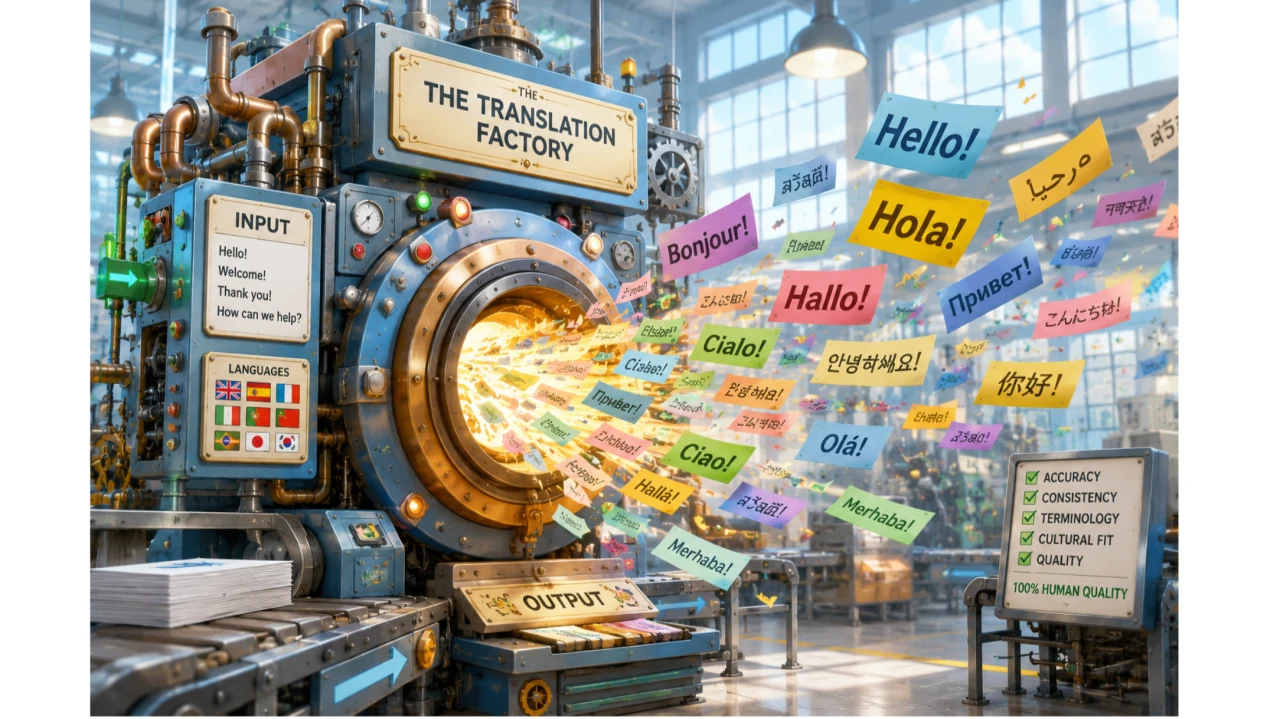
AI can generate thousands of translated words in minutes. That does not mean the human work of checking them has disappeared.
The language industry has always relied on word counts. They're easy to measure, easy to price and easy to put into a spreadsheet. But there's a problem when we start treating a word count as an accurate measure of work: a word is not a unit of human effort.
This distinction matters more than ever. AI and machine translation can generate huge volumes of text almost immediately. Human reviewers, however, still have to read, compare, understand and make decisions. Technology has accelerated the production of a first draft; it hasn't made human attention unlimited.
Machine capacity is not review capacity
Consider a hypothetical 50,000-word project. A machine can generate a draft very quickly. A qualified reviewer still needs to check whether the translation matches the source, whether terminology is correct, whether anything has been omitted or added, and whether the result is suitable for its audience.
Depending on the content and the quality of the machine output, that could be several days of concentrated work. The exact time varies, of course. What matters is that the workload doesn't vanish because the first draft arrived instantly.
Two projects with the same number of words can require very different amounts of effort. A repetitive, well-prepared technical manual with established terminology is not the same as a complex legal document where a small wording change can alter an obligation. Yet project estimates are often reduced to a familiar formula: word count × rate × deadline.
It's a useful starting point for commercial discussions. It isn't a complete production plan.
What a CAT-tool analysis doesn't tell you
Translation memories, fuzzy matches and MTPE calculations help estimate cost. But discounted or weighted effort words must not be confused with the actual amount of text that needs attention.
Imagine 50,000 source words that a CAT-tool analysis values at 20,000 effort words. The lower figure may make sense for pricing. It doesn't necessarily mean someone can sign off the full 50,000-word deliverable in the time normally allocated to 20,000 words.
The distinction becomes particularly important with TEP—translation, editing and proofreading. If the service includes a complete review, the project schedule must make room for that review, regardless of how matches and machine-translated segments are discounted.
There is another hidden cost: file preparation. Translators and reviewers sometimes receive poorly prepared files filled with unnecessary tags and technical clutter. Finding the translatable text and keeping the structure intact takes time and attention. A word count won't show that effort either.
Light post-editing doesn't mean turning off professional judgment
A lighter post-editing scope can be perfectly valid when the intended use and quality expectations are agreed in advance. But it needs to be defined properly.
Even when the objective is only understandable output, a professional must still recognize critical meaning errors, misleading wording and incorrect terminology. Reading a fluent sentence is easy. Detecting that it says something different from the source can be much harder.
Poor machine output may require substantial rewriting. Good machine output can be quicker to edit, but it still requires verification. The volume of visible edits is not a reliable measure of the attention required to decide that a segment is correct.
A two-day deadline doesn't create five days of capacity
Consider another hypothetical situation: a 50,000-word machine-translated document is needed within two days, with full human review included.
If the required checks realistically need four or five working days from the available team, pressure alone won't change that. Someone must revisit the deadline, the scope, the number of reviewers or the quality requirements. Pretending those variables don't exist simply transfers the problem to the linguists.
The same applies when several translators divide the work. Parallel production can shorten the first stage, but it brings a separate need for coordination, terminology alignment and final consistency review. Six translators working on different chapters won't necessarily produce a document that reads as if one person wrote it.
And that final review is often the stage missing from the original calculation.
The conversation needs to happen before the promise
This is where project management makes a difference. A good PM should be able to say:
- We can meet the deadline, but the review scope would need to change.
- We can deliver the agreed quality, but we need more time.
- We can add resources, provided we also schedule consolidation and final review.
These are professional answers, not excuses. Once an unrealistic deadline has been promised, the production team has very little room to negotiate. It is expected to absorb the consequences of a commercial decision it may not have been consulted about.
Having worked with large multilingual teams, we believe the most effective approach is to estimate the full workflow, not just the time required to produce a draft.
What should a realistic estimate include?
For significant translation and localization projects, the planning discussion should cover more than the source word count:
- Content complexity and risk. Is this internal reference material, software UI, legal content, a technical manual or safety-critical information?
- Actual MT quality. Has the proposed engine been evaluated on comparable content and the same language pair?
- Terminology and reference materials. Are they reliable, current and available to everyone involved?
- File readiness. Are the files prepared correctly, or will linguists have to spend time managing tags and structure?
- Team capacity. How many qualified translators and reviewers are genuinely available, and when?
- Consolidation and quality checks. Who will ensure consistency across all contributors, and how much time is reserved for the final review?
- The agreed quality level. What does acceptance mean for this particular project, and who is responsible for signing it off?
These questions may add a little time to the planning stage. They can save much more time later by avoiding rushed corrections, missed deadlines and disagreements about what was actually ordered.
Faster production is valuable. So is realistic planning.
None of this is an argument against AI, machine translation, MTPE or CAT-tool analysis. These technologies can make localization much more efficient. They help professionals focus on the work where human judgment adds the most value.
The mistake is assuming that the speed of generating text also determines the speed of validating it.
Word count measures volume. It doesn't, on its own, measure workload. And the closer we move toward large-scale automated production, the more important that distinction becomes.
At MITO Solutions, we approach localization as a coordinated process involving the right linguistic expertise, realistic resource planning and the quality checks appropriate for the content. We are happy to discuss workflow design, multilingual project coordination and linguistic QA with organizations that want to improve both efficiency and quality.
If you are planning a multilingual project and would like to review its production assumptions, we'd welcome the conversation.
MITO Solutions · contact@mitosolutions.com
Originally written by Miklós Tóth and published on LinkedIn on 25 August 2026. Adapted for MITO Solutions.