
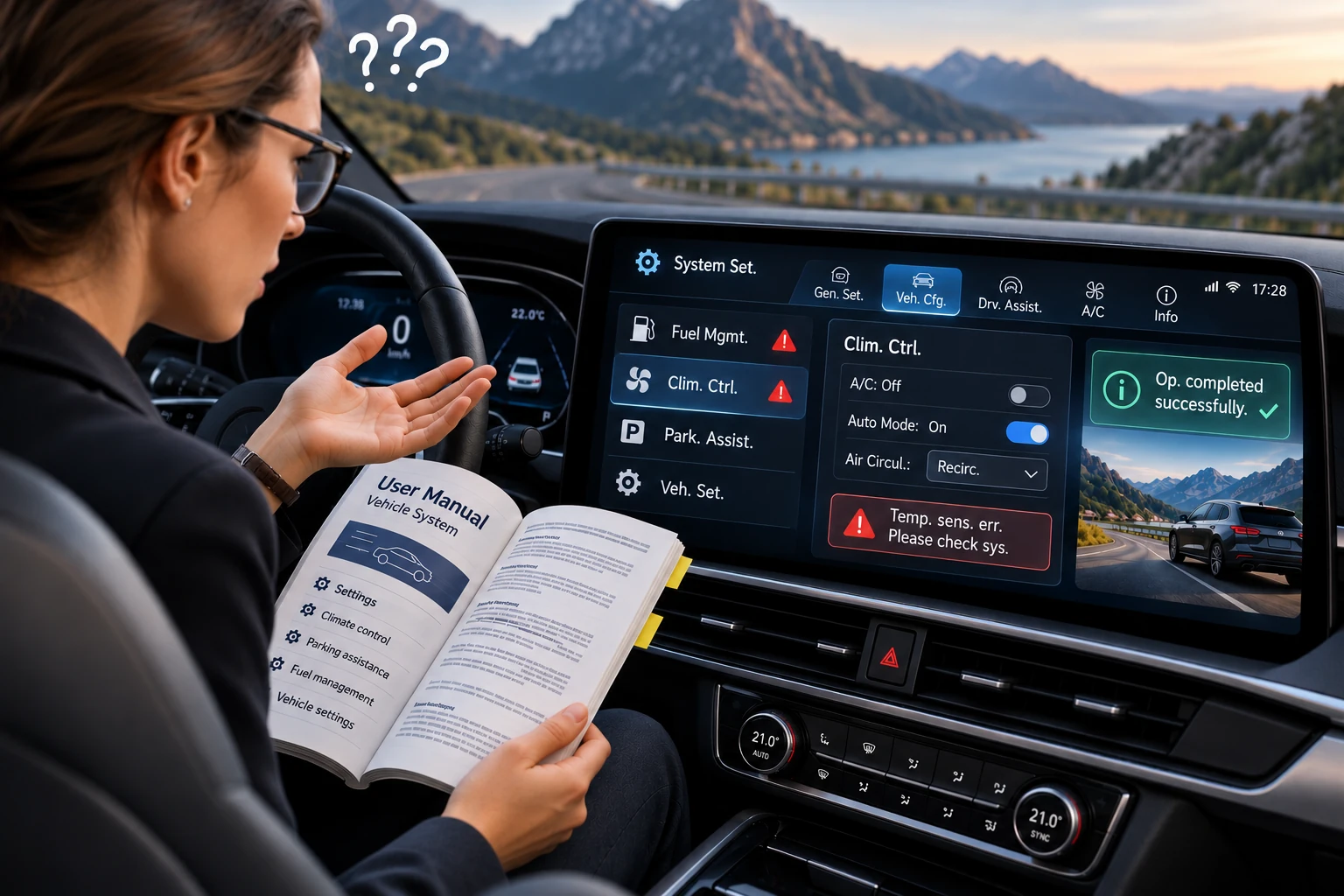
A vehicle interface can be translated correctly and still leave its driver uncertain. The real test is whether language works across the complete driving experience—not just in a spreadsheet.
There is an uncomfortable question at the heart of automotive localization. Miklós Tóth, the founder of MITO Solutions, works with vehicle interfaces and technical automotive content. Yet in his own car, he prefers to keep the interface in its original language. Why would someone whose work involves bringing vehicle technology closer to Hungarian drivers make that choice?
The answer is not that translating a car is pointless, or that the original wording is necessarily better. It is that localization only succeeds when the driver can understand and trust what the entire vehicle is telling them. A string may be linguistically accurate but still feel unfamiliar, inconsistent or unclear when the driver encounters it on a screen.
A car is not a collection of isolated strings
Modern vehicles communicate through several connected channels: instrument clusters, infotainment screens, driver-assistance notifications, companion apps, owner’s manuals and aftersales documentation. These may be produced by different teams, released on different schedules and reviewed with different tools.
From a production perspective, they can look like separate content streams. From the driver's perspective, they are one product.
A function described one way in a vehicle menu should not suddenly acquire another name in the owner’s manual or a third expression in the mobile app. When that happens, users have to work out whether the terms refer to the same feature. The translation may be defensible in each individual file, but the overall experience becomes harder to navigate.
Terminology consistency is therefore a usability requirement, not simply a matter of linguistic style.
What a translator cannot see matters
A great deal of automotive localization still begins with lists of short interface strings. The translator may receive a phrase without the screen it appears on, without knowing whether it is a setting, a warning, a button or an explanation, and sometimes without enough information about the function itself.
Character limits add another complication. A short term that fits beautifully into a text field may be confusing to a driver. A longer, clearer phrase may not fit the interface. Neither problem can be resolved properly by checking grammar alone.
This is why context has to arrive early: screenshots, feature descriptions, neighbouring strings, approved terminology and information about how the interface behaves. When questions arise, linguists need a way to reach the people who understand the product. Otherwise, reasonable assumptions may become permanent interface decisions.
Correct on paper is not always clear on the road
Reading a translated menu at a desk is different from interacting with it in a vehicle. The user may be unfamiliar with a newly introduced function. They may be navigating an already crowded screen, trying to identify a setting, or looking for the explanation of a warning.
That is the point at which the distinction between linguistic correctness and product quality becomes visible. Does the label identify the function clearly? Is a warning immediately understandable? Does the wording match the instruction in the manual? Are abbreviations meaningful to the person using the car, rather than just to the person who created the source string?
These questions are difficult to settle by reviewing bilingual segments alone. They call for linguistic QA in context—ideally with screen-level validation and, where possible, checks in a functioning interface or vehicle.
AI can speed up translation. Context still needs to be managed.
Machine translation and AI-assisted workflows can help process large amounts of automotive content, propose terminology and highlight inconsistencies. They are useful tools, particularly when vehicles, software releases and markets multiply.
But the technology is only as well informed as the workflow around it. A fluent translation does not prove that a system understood the vehicle feature, the available screen space or a terminology decision made in another document. An automated check may find a repeated term; it may not detect that two different terms refer to the same button in the car.
Strong automotive localization therefore combines technology with domain knowledge and clear accountability. Someone still has to make—and verify—the decisions that affect the user.
What a more reliable process looks like
For manufacturers and suppliers, the practical improvements are not mysterious. They require treating localized language as part of the product lifecycle:
- Manage terminology across products. Link the vocabulary used in the vehicle, owner’s literature, connected apps and service information, rather than maintaining isolated glossaries.
- Provide functional context. Give translators and reviewers access to screenshots, feature explanations, interface states and the intended audience for each message.
- Review user journeys, not only segments. Check how a driver finds, activates and understands a function through a sequence of screens.
- Test the rendered interface. Validate truncation, abbreviations, consistency and clarity in realistic layouts, with functional testing where practical.
- Keep a route for expert feedback. Allow linguists, engineers, product teams and technical authors to resolve uncertainties and share decisions across releases.
These measures do not mean that every word requires expensive manual intervention. They mean directing expert attention to the places where a superficially correct translation could still create confusion.
The goal is a car that feels natural in the driver's language
A driver should not have to choose the original interface language simply because the localized version feels unfamiliar or because the terminology differs from the manual. A well-localized vehicle should make its functions easier to understand, not require users to learn a second vocabulary.
At MITO Solutions, we approach automotive translation, terminology and linguistic quality assurance as connected disciplines. The objective is not only to deliver accurate Hungarian strings, but to help ensure that those strings work where drivers actually encounter them.
When someone who works with automotive localization still prefers the original interface language, the response should not be to dismiss translation. It should be to ask what needs to improve in the complete experience.
If your team needs specialist Hungarian automotive localization, independent linguistic QA or terminology review, you can contact us at contact@mitosolutions.com.
Based on themes discussed by Miklós Tóth in his original LinkedIn article, “I Translate Car Interfaces for a Living. So Why Do I Use Mine in the Original Language?” This version was written for MITO Solutions with a focus on product quality and localization workflows.