Why professional linguistic expertise matters both when AI systems are trained and when their output is reviewed.
AI is changing how companies produce and localize content. But one question deserves more attention: who is teaching these systems what good language actually looks like?
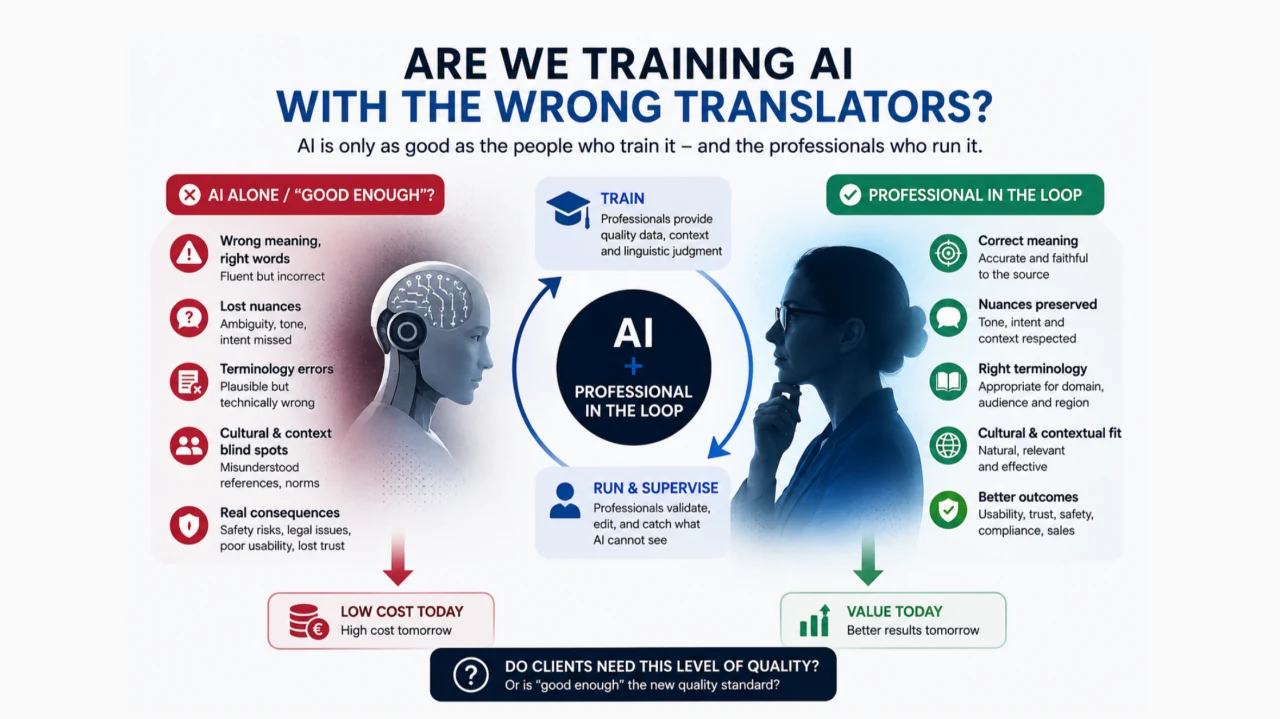
At MITO Solutions, we believe that the familiar phrase “human in the loop” misses an important distinction. For demanding language work, it isn't enough to involve just anyone. What matters is having the right professional in the loop—someone who understands the language, the subject, the audience and the consequences of an error.
Fluent doesn't always mean correct
AI-generated translations can read naturally while still getting important things wrong. A system might:
- choose the wrong meaning of an ambiguous word;
- omit a small but important piece of information;
- change how certain or obligatory a statement sounds;
- select technically incorrect terminology that nevertheless feels natural;
- misunderstand a reference or the relationship between sentences;
- overlook cultural or social implications; or
- translate literally when the meaning calls for adaptation.
These mistakes are not always obvious. Fluency can make a translation look more reliable than it is. A reviewer may need substantial linguistic and subject-matter expertise to identify what's missing or misleading.
What happens when experienced professionals stop accepting the work?
AI training, evaluation and machine translation post-editing all require attention and judgment. Yet there is growing pressure to reduce their costs.
In professional discussions, experienced linguists have described turning down AI-training and post-editing assignments when the rates do not reflect the expertise required. That raises a difficult question: if highly qualified professionals decide the work is no longer worth accepting, who will take their place?
Lower rates do not prove that a project uses less-qualified reviewers, and the people who accept those rates are not automatically less capable. But a procurement model that rewards the lowest cost without adequately measuring expertise risks losing the very people best equipped to recognize subtle errors.
That matters not only for the output delivered today, but also for the quality of the evaluations and feedback used to improve tomorrow's systems.
Professionals are needed after deployment, too
Even when an AI model benefits from strong training data and careful evaluation, professional oversight does not suddenly become unnecessary.
The work changes. Instead of translating every sentence from scratch, a linguist may spend more time checking the model's interpretation, spotting difficult cases, correcting recurring problems, protecting terminology and deciding when the output should not be trusted.
This calls for a different workflow—not the absence of expertise. The same professional judgment that helps build and evaluate AI systems remains valuable when those systems are used in real projects.
Is “good enough” really good enough?
Not all content has the same quality requirements. A rough translation that helps someone understand a low-risk internal message may be entirely appropriate. AI can make information available at a scale and cost that were previously impractical.
But technical documentation, software interfaces, safety information and customer-facing communication present different risks. In these settings, seemingly small differences in meaning, terminology or obligation can matter.
The real discussion should therefore move beyond the familiar question, “Will AI replace translators?”
A more useful question is: how much professional expertise are organizations willing to retain when AI produces text that appears good enough?
And if “good enough” becomes the default quality target, who will continue defining and checking what good means?
How MITO Solutions approaches the question
Our view is that AI and human expertise should support one another. Technology can assist with productivity and consistency, while experienced specialists provide the context, domain knowledge and independent judgment needed to assess the result.
For clients using AI-assisted translation, MTPE or language-model evaluation, we favour a risk-based quality approach: match review effort and reviewer expertise to the content's purpose and potential impact, rather than treating every text as equivalent.
MITO Solutions works with translation, linguistic quality assurance and AI/MT evaluation, with Hungarian as our core language specialization and multilingual project-management experience across international programs.
If your organization is reviewing its AI-assisted localization workflow, we'd welcome a conversation about how to build professional quality checks into the process.
Website: www.mitosolutions.com
Contact: contact@mitosolutions.com
Originally written by Miklós Tóth and published on LinkedIn on 18 August 2026. Adapted for the MITO Solutions website.