As AI becomes better at producing fluent translations, the ability to question its decisions becomes more important.
For a long time, the skills expected of a professional translator were relatively clear: excellent language skills, subject-matter knowledge, terminology management, cultural awareness and the ability to write well. Those skills still matter. But AI-assisted translation is changing where professional judgment is most valuable.
A system can now produce fluent text in seconds. That raises a question for language buyers, localization managers and linguists alike: who decides whether the output is actually correct, appropriate and safe to publish?
At MITO Solutions, we see an increasingly important role for what founder Miklós Tóth calls the AI-aware translator: a language professional who understands both the subject matter and the ways AI can fail, and who can make informed decisions about the output rather than simply polishing its wording.
Fluency is not accuracy
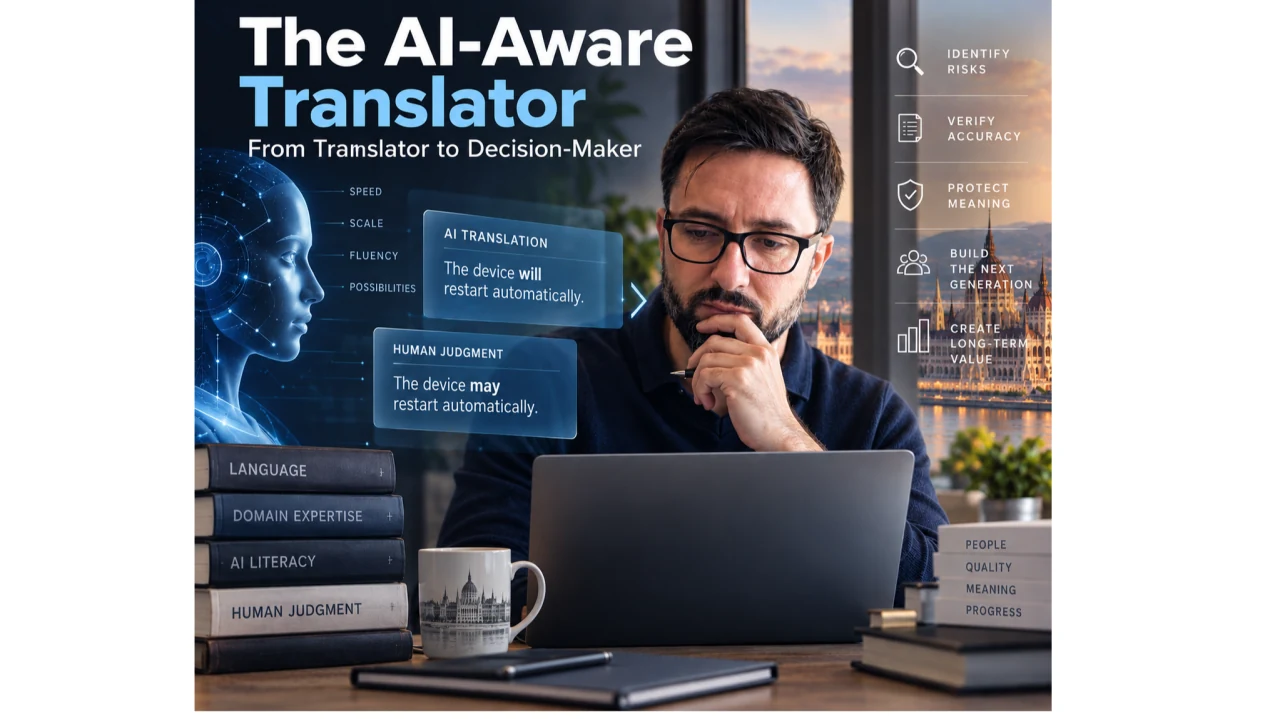
Consider this source sentence:
The device may restart automatically.
An AI-generated translation might convey:
The device will restart automatically.
Both statements read naturally, but the meaning has changed. A possibility has become a certainty. In a technical manual, a software warning or a medical document, that difference may matter far more than stylistic elegance.
This is why it is not enough to know that AI occasionally makes mistakes. Reviewers need to understand how it makes them. AI output can:
- resolve an ambiguity that should remain open;
- change possibility into certainty or weaken an obligation;
- add unsupported information or omit a qualification;
- choose a fluent but imprecise term;
- make assumptions that the source does not justify;
- use incorrect terminology consistently; or
- subtly alter the intended tone or meaning.
Such errors can be harder to spot than poor grammar because the sentence sounds convincing. A professional reviewer has to check what the source actually says, not only whether the translation sounds good.
From language production to risk assessment
AI also changes how review effort should be allocated. Not every sentence carries the same risk. A marketing tagline, a product description, a vehicle safety warning and a medical dosage instruction require different levels of scrutiny.
An AI-aware linguist asks two questions: Is the output correct? and What happens if we accept it without further checking?
For a low-risk internal summary, a light review may be appropriate. For high-impact technical or user-facing content, the process may require source-to-target verification, terminology checks, subject-matter input and in-context linguistic testing.
The distinction matters commercially. A model may generate 50,000 words in a short time, but that does not mean a qualified reviewer can evaluate all 50,000 words with the same speed or attention. Scaling text generation and scaling professional judgment are very different tasks.
The objective should therefore be to use human attention intelligently—not to assume that fluent output no longer needs it.
A concern for the next generation of linguists
There is another question that deserves attention: how will junior translators develop the judgment we increasingly expect from AI reviewers?
Traditionally, experience came from translating, making mistakes, receiving feedback, revising work and gradually learning to recognize difficult decisions. New linguists increasingly encounter workflows where the first draft is produced by a machine and their task is to review it.
That can be productive, but it creates a learning challenge. Someone may become accustomed to correcting AI output without having had sufficient practice developing solutions independently. They may learn that a sentence sounds right without always understanding why it is right—or when a plausible sentence should be rejected.
This does not mean that every junior linguist must spend years translating entirely without tools. It means that training cannot be reduced to checking AI suggestions. Future experts still need guided practice, detailed feedback, source-text analysis and opportunities to justify their decisions.
The risk is not simply that AI will replace entry-level tasks. It is that the industry could weaken the path by which today's juniors become tomorrow's experienced reviewers and quality leads.
What an AI-aware localization workflow looks like
Job titles will vary, but the capabilities behind the role are increasingly clear. A strong AI-assisted localization process should:
- Define the required quality and risks. Identify whether the content is routine, sensitive, regulated, safety-related or customer-facing before selecting a workflow.
- Provide context and reliable references. Approved terminology, audience information, product context and writing requirements must be accessible to both the system and the reviewer.
- Use professionals who can challenge the output. Reviewers need source-language and target-language expertise, relevant domain knowledge and familiarity with AI failure modes.
- Make review proportionate to risk. A high-impact warning should not be checked in the same way as a disposable internal note.
- Record and learn from recurring errors. If a model consistently changes modal verbs or chooses the wrong technical term, the process should address the pattern rather than correcting individual sentences forever.
- Invest in the next generation. Junior linguists need mentoring, purposeful exercises and feedback that develops independent judgment.
These are not arguments against AI. On the contrary, AI can be extremely useful for terminology research, draft generation, consistency checking and other repetitive tasks. The value comes from integrating it into a process where human responsibility is clear.
The real value is knowing when to disagree
The translation profession is not only shifting from writing toward reviewing. At its best, it is shifting toward making better-informed decisions: deciding where automation is appropriate, which errors matter most, what requires further investigation and when a fluent answer is not good enough.
A strong reviewer must sometimes be able to look at a polished translation and say, “No. This is wrong.” That decision may depend on years of experience that no interface can replace with a green checkmark.
For localization buyers, the question is therefore not simply how many words AI can produce or how much a post-editing workflow saves. It is who takes responsibility for the accuracy and suitability of the published content, and whether they have the expertise and time to do so.
Applying these ideas at MITO Solutions
MITO Solutions combines professional linguistic expertise with AI-assisted quality workflows. Our focus includes localization quality assessment, AI and MT output evaluation, terminology management and practical workflow improvements, with Hungarian as our core language specialization and broader multilingual project-management experience.
We welcome discussions with organizations seeking to introduce AI responsibly, improve linguistic QA or design review processes that match the risks of their content.
The future of localization is not simply producing more language. It is knowing which language decisions we can trust.
Explore MITO Solutions · contact@mitosolutions.com
Originally published by Miklós Tóth on LinkedIn on 22 September 2026. Adapted for MITO Solutions. Read the original article.